How SpaceX's reusable rockets work — and why they rewrote the economics of space
For sixty years, rockets were thrown away after one flight — imagine scrapping a 747 after a single trip. SpaceX's reusable rockets broke that rule by doing the hard thing: flying the most expensive part of the rocket back and landing it to fly again. One Falcon 9 booster has now flown 35 times. Here's how reusability actually works — and a free browser game, LANDING BURN, that lets you fly the landing yourself.
The idea: don't throw the expensive part away
A rocket's first-stage booster — the big bottom segment with most of the engines — is the priciest piece of hardware, roughly two-thirds of the cost. Traditional rockets dump it in the ocean after a couple of minutes of use. SpaceX's insight was that if you could land that booster intact, you could inspect it, refurbish it lightly, and fly it again — spreading its build cost across many missions instead of one.
How a booster comes home
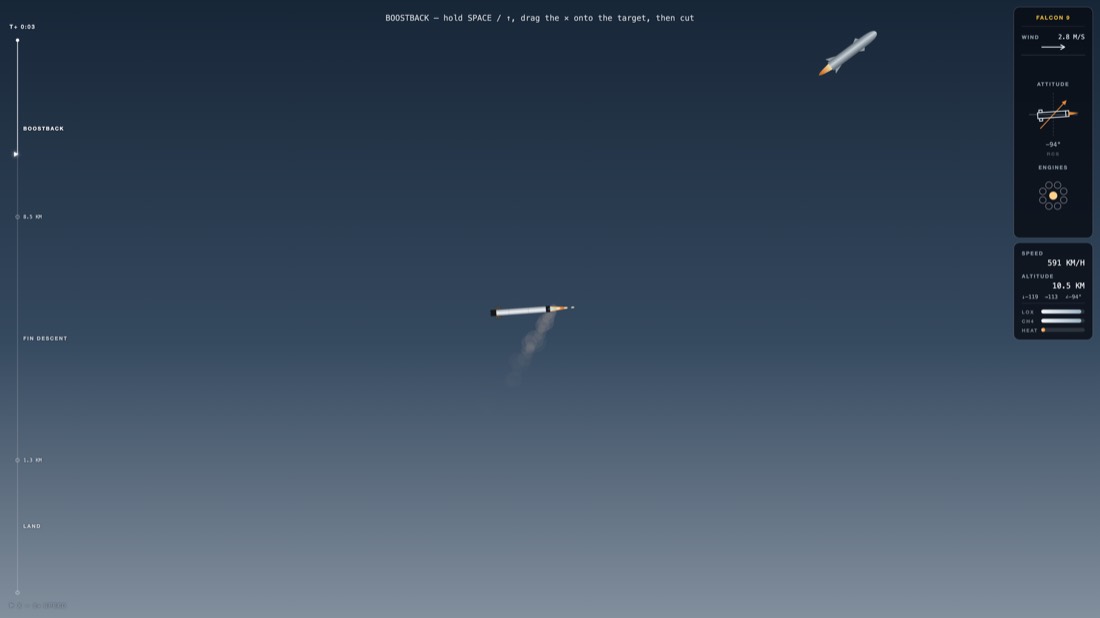
Recovery is a whole flight in itself. After separating from the upper stage, the booster flips engines-forward and fires a boostback burn to aim back toward land or a waiting droneship. It steers through the atmosphere on grid fins, then lights a single, late suicide burn (hoverslam) to hit zero velocity exactly at touchdown, and drops its legs. That's the Falcon 9 method — and the first mission in the game.
The bigger Super Heavy booster has no legs at all: it's caught out of the air by the launch tower's chopstick arms, saving even more landing weight.
Why it saves so much money
- Refurbishment ≈ a tenth of new-build. A landed booster needs inspection and light work, not a fresh factory build — roughly 10% of the cost of making a new one.
- Price per kilogram collapses. Reuse helped push a Falcon 9 launch to around $60 million and roughly $2,700-3,000 per kg to low Earth orbit, versus well over $10,000 per kg on expendable rockets.
- Flight rate explodes. Not having to build a booster for every launch lets SpaceX fly at a cadence the rest of the industry can't match.
- The hardware just keeps going. Block 5 was designed for 10+ flights; in practice boosters are now well past 30, with the fleet closing on the Space Shuttle orbiter's 39-flight record.
From partial reuse to full reuse
Falcon 9 reuses the booster and the fairings, but expends the upper stage. Starship is SpaceX's bet on full reusability — booster and ship both recovered and reflown, the way an airliner is. That's why Starship flies the dramatic belly-flop and flip and why even a Mars landing is built around bringing the whole vehicle down in one piece. (For the side-by-side, see Starship vs Falcon 9.)
Fly the part that makes it work
Landing the booster is the genuinely hard bit — the thing that turns an expensive throwaway into a reusable vehicle. LANDING BURN drops you into exactly that, free, no download, on desktop or phone. Fuel left over is your score, which is precisely what the real program optimises.
FAQ
- Which parts of a SpaceX rocket are reused?
- On Falcon 9: the first-stage booster and the payload fairings. The upper stage is expended. Starship aims to reuse everything.
- Where do the boosters land?
- Either back at a coastal landing zone, or on an autonomous droneship at sea (with names like "A Shortfall of Gravitas" and "Of Course I Still Love You") for higher-energy missions.
- Is reusing rockets actually safe?
- The flight record suggests so — individual boosters have flown 30+ times. Each is inspected between flights, and the design margins were built for repeated use.
- Can I try it without downloading anything?
- Yes — LANDING BURN runs in any browser and on phones, free.