The Super Heavy booster catch is the hardest trick in rocketry — here's a game where you fly it
In May 2026, Starship Flight 12 sent the first Starship V3 to space on brand-new Raptor 3 engines — and lost the Super Heavy booster on the way back, when its engines failed to relight after separation. No boostback, no landing, no catch. If that made you wonder what it actually takes to bring a 70-metre steel tube home onto two robot arms, LANDING BURN lets you find out — free, in your browser, no download.
▶ FLY THE BOOSTER CATCH — FREE
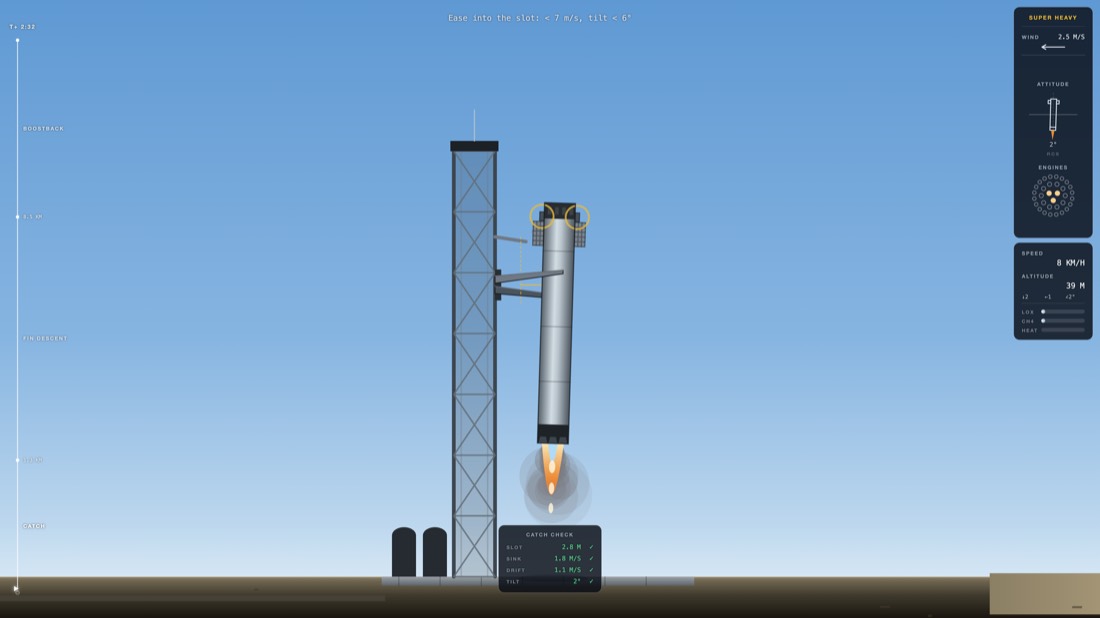
How the Mechazilla chopstick catch works
Super Heavy has no landing legs. Instead of touching the ground, it comes to a hover next to the launch tower and hangs two small catch pins — hardpoints near the top of the booster — onto a pair of giant mechanical arms. The arms (the chopsticks, the whole tower nicknamed Mechazilla) ride rails up and down the tower, adjusting their height in the final seconds to meet the booster where it is, then lower it back onto the launch mount. No legs means less weight, and a booster that can be set down, restacked and flown again fast.
Why it's so much harder than a droneship landing
A Falcon 9 gets a barge the size of a football field and legs that forgive a sloppy touchdown. The catch forgives almost nothing:
- A 13-metre slot. The booster has to arrive between the arms — miss left and you hit a very solid steel tower; miss right and there is nothing under you at all.
- Pins, not a deck. You don't land on something — you have to settle the pins into a band barely two metres tall while the arms track you.
- Nearly vertical, nearly still. Sink rate under ~7 m/s, sideways drift under ~4.5 m/s, tilt within a few degrees — all at the same instant, all after falling from 100 km.
- It starts with the boostback. As Flight 12 showed, if the engines don't relight right after separation, nothing else matters. The catch is the last link in a chain that begins seconds after staging.
Flying it in LANDING BURN
The game's tower mission is the real profile, end to end: separate, flip retrograde, fire the boostback burn until your predicted impact point sits on the tower, cut, coast, swing tail-first before the atmosphere bites, glide in on the grid fins — and then thread the needle. The chopsticks behave like the real ones: the arms ride the tower rails and chase your altitude in the final approach, parking themselves just under your pins. A live catch check shows every limit — slot, sink, drift, tilt — and turns green only when all of them pass. When you miss, it tells you exactly why. Fuel left is your score, so the leaderboard rewards the latest, bravest burn you can survive.
Warm up on the Falcon 9 droneship landing first — two clean landings unlock the tower. After that, there's a Starship Mars mission waiting.
FAQ
- Is there a game where you catch the booster with the chopsticks?
- Yes — this one. LANDING BURN's tower mission is a full Mechazilla-style catch with adaptive arms and real physics. Play it free in your browser.
- Why didn't Flight 12 attempt a catch?
- It was the first flight of the redesigned V3 vehicle, so SpaceX planned a water landing in the Gulf instead. The booster's engines failed to relight after separation and it was lost before any landing attempt.
- Do I need to install anything?
- No. It runs in any browser, desktop or phone. On mobile you hold one BURN button and steer by tilting your phone.
- Is this an official SpaceX game?
- No — it's an independent fan-made arcade simulation inspired by the Super Heavy catches, the Falcon 9 landings and the Starship Mars architecture.