How does SpaceX land rockets? The honest answer is a controlled near-crash
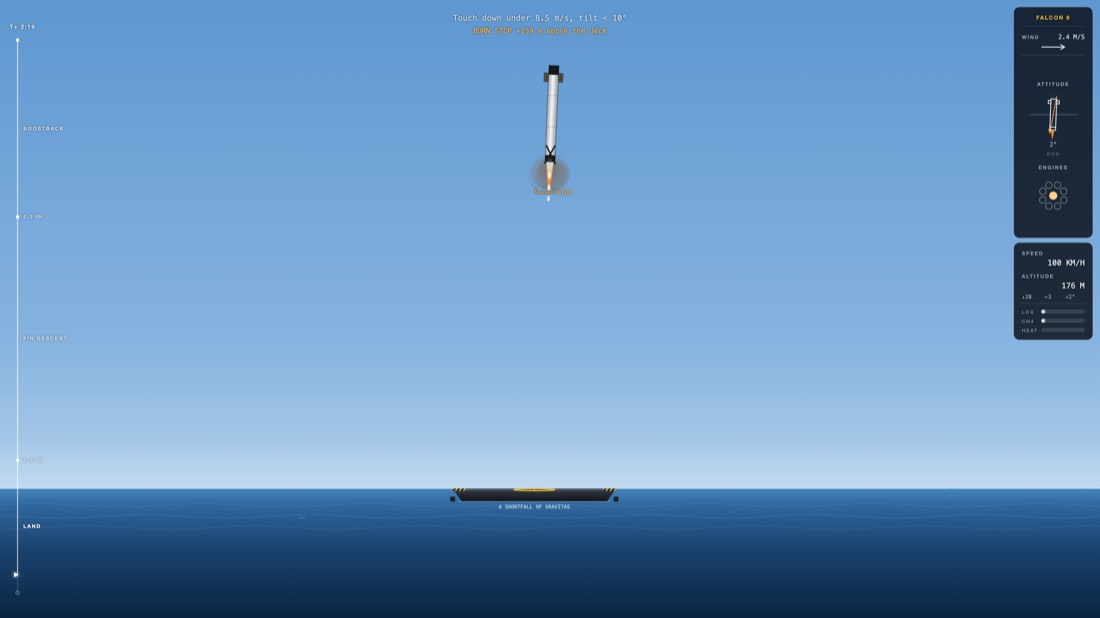
Watch a Falcon 9 booster settle onto a droneship and it looks serene — like the rocket is being lowered on a string. It isn't. What you're seeing is a suicide burn: a single, late, full-power engine burn timed so precisely that the booster's downward speed reaches zero at the exact instant its legs touch the deck. Here's how the whole thing works — and if you want to feel why the timing is so brutal, LANDING BURN lets you fly it free in your browser.
Step 1 — flip around and boost back
Right after the booster separates from the upper stage, it's still screaming downrange at hypersonic speed. It uses cold-gas thrusters to flip engines-forward, then fires a boostback burn to kill that horizontal velocity and throw its predicted landing point back toward the pad or the waiting droneship. Get this wrong and nothing downstream can save the landing.
Step 2 — fall, and steer with grid fins
The engines cut and the booster coasts up and over the top of its arc, then plummets. Four grid fins near the top deploy and act like control surfaces, nudging the falling body so it tracks toward the target and stays pointed engines-first through the worst of the reentry heating. Boosters never belly-flop — that's a Starship move. A Falcon 9 comes home tail-first the entire way down.
Step 3 — the suicide burn (hoverslam)
This is the part that looks impossible. The booster does not slow down early and hover in. Instead it falls almost all the way to the deck, then lights its center engine at high thrust at the last possible second. Done right, the deceleration curve brings vertical speed to zero right as the legs meet steel.
Why so dramatic? Because a fuel-burned Falcon 9 booster is so light that one engine at its lowest throttle still pushes harder than the rocket weighs — it physically cannot hover. And braking gently from high up would burn a fortune in propellant just fighting gravity on the way down. The latest, hardest burn that physics allows is also the most fuel-efficient one. The serene landing is the consequence of the scariest possible plan executed perfectly.
Why "burn late" is the whole game
In LANDING BURN, fuel left over is your score — exactly the metric the real program optimises. So the leaderboard meta converges on what SpaceX actually does: drag the predicted-impact mark onto the target during boostback, coast the arc, and then trust the STOP marker and burn as late as your nerve allows. The marker even models engine spool-up time, so it's honest about how little margin you really have.
▶ TRY THE SUICIDE-BURN TIMING NOW
FAQ
- What's the difference between a suicide burn and a hoverslam?
- Nothing — they're two names for the same maneuver. "Hoverslam" is the SpaceX-flavoured term; "suicide burn" is the older spaceflight-sim name. Both mean: one late, hard burn to zero velocity at the surface.
- Does SpaceX land on land or at sea?
- Both. High-energy missions land the booster on an autonomous droneship downrange; lighter ones boost all the way back to a landing zone on the coast. The first mission in the game is the droneship version.
- How do they catch the Super Heavy booster instead?
- The bigger Starship booster has no legs — it's caught by the tower's chopstick arms. We broke that down in the Super Heavy catch article.
- Can I really practise this in a browser?
- Yes. LANDING BURN is free, no download, and works on phones. The timing is the whole point.