Why Starship belly flops — and why the flip is the scary part
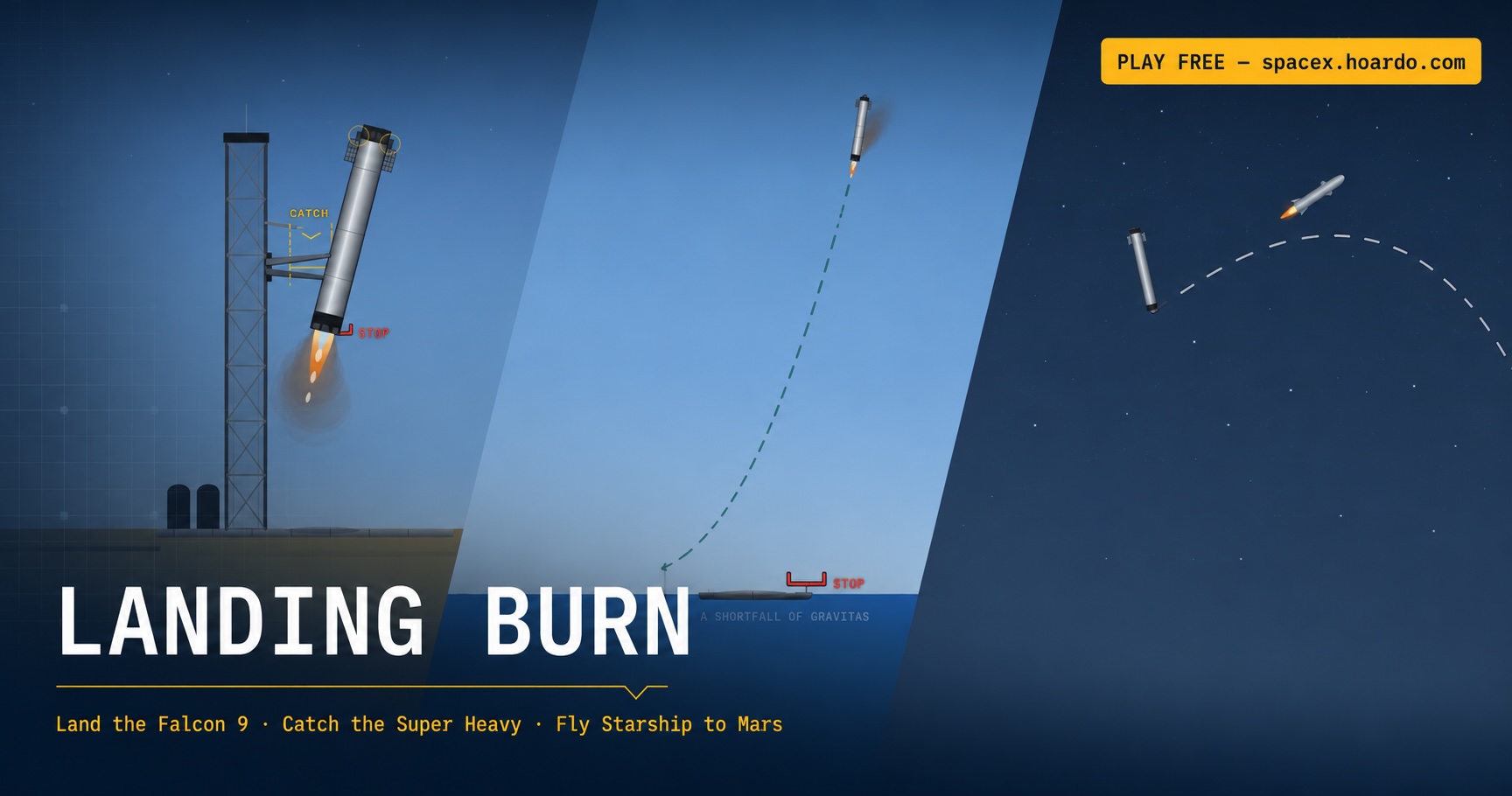
Starship comes back from space lying on its side, falling flat like a skydiver, before snapping vertical at the last moment to land. It looks absurd. It's also the smart move. Here's why Starship belly flops, what the flip maneuver actually does — and a free browser game, LANDING BURN, that lets you fly the whole thing.
The belly flop is a free airbrake
A skydiver spreads out to fall slower. Same idea: by falling belly-first, Starship turns its entire flank into a giant airbrake. The atmosphere does the work of bleeding off speed, so the engines don't have to spend fuel doing it. For a vehicle that's big and — once its tanks are nearly empty — quite light, that's a huge propellant saving. Four flaps (two up front, two at the tail) twist like an air-brake-and-rudder combo to keep the ship stable and steer it toward the landing site while it falls.
The flip turns it back into a rocket
You can't land on your belly. So a few hundred metres up, Starship flips from horizontal to vertical and relights its engines, arresting the last of its velocity for a tail-down touchdown. This transition is brief and violent — the ship trades aerodynamic control for engine control in a couple of seconds, and there's no time to recover if it's mistimed. It's the moment every Starship landing lives or dies on.
Why only Starship does this
Boosters don't belly flop. A Falcon 9 or Super Heavy comes home engines-first, steering with grid fins and braking with a late suicide burn. The belly flop is specific to Starship's shape, mass and heat-shielded flank — try it on a booster and you'd be fighting physics the vehicle was never built for. Keeping that distinction straight is half of understanding how SpaceX recovers each stage.
Fly the belly flop on Mars
In LANDING BURN's Starship Mars mission, belly-flop physics are live: a broadside, weak-flap descent through a thin atmosphere, then the flip to vertical for a landing burn. Mars makes it even meaner — 38% gravity and 1% of Earth's air — so the flaps barely bite and the flip has to be near-perfect.
FAQ
- Does the belly flop save fuel?
- Yes — that's the point. Maximising drag lets the atmosphere shed speed for free, so the engines only need enough propellant for the final flip-and-burn.
- Why is the flip so risky?
- It's a fast handoff from aerodynamic control (flaps) to thrust control (engines) just above the ground, with no margin to retry. Timing and engine relight have to be exactly right.
- Where can I see it in the game?
- The Mars mission in LANDING BURN — the only mode with belly-flop physics. It unlocks after you join the flight roster.