A Mars landing game where the atmosphere is too thin to save you
Landing on Mars is its own special nightmare: there's just enough air to cook you on the way in, and nowhere near enough to slow you down. LANDING BURN's third mission drops you into exactly that — flying a Starship's full entry, belly flop, flip and powered landing on the Martian surface, free, in your browser.
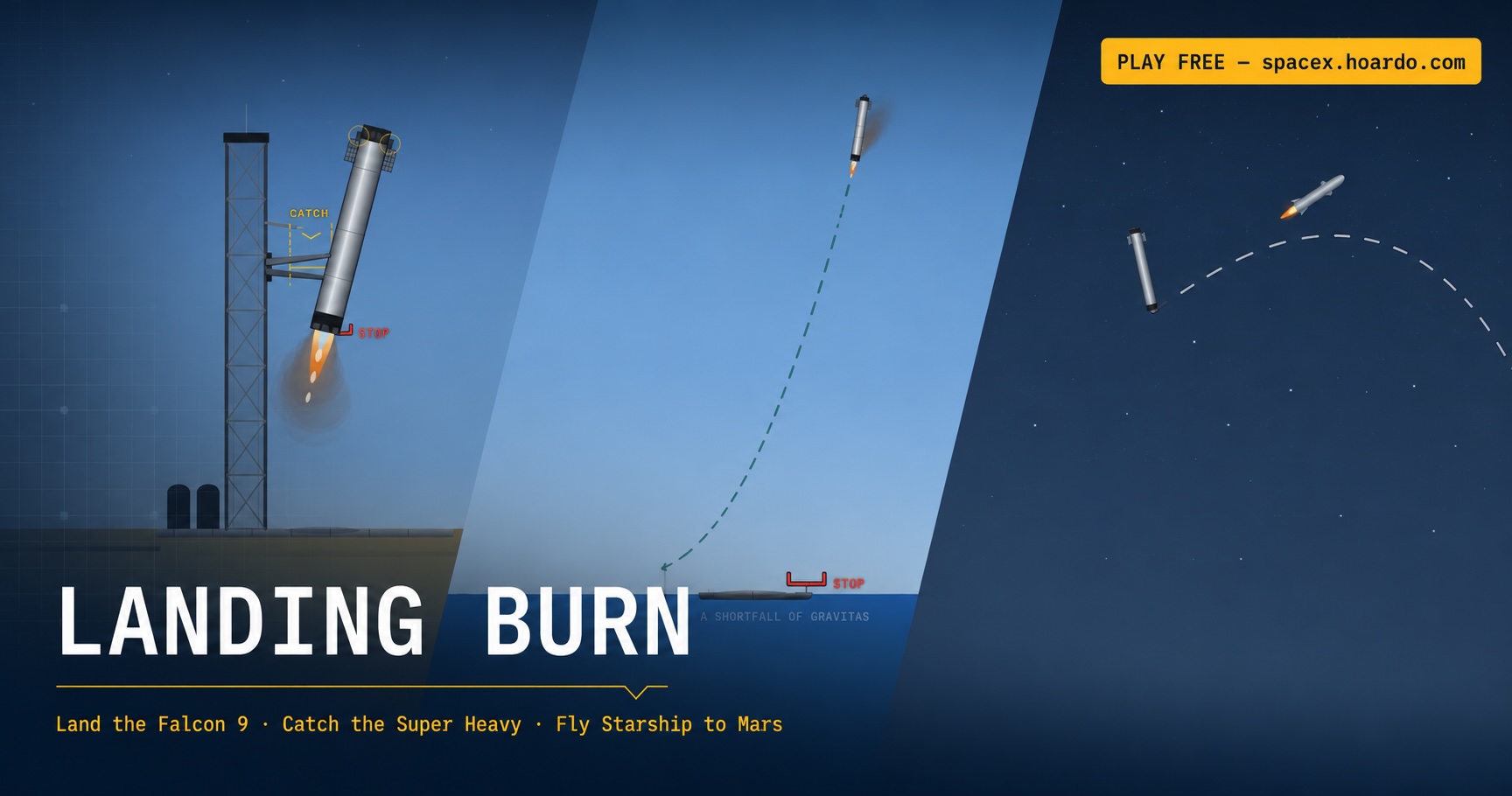
What makes Mars the hardest mode
- 38% gravity. You fall more gently, but your engines also have less weight to cancel — the whole feel of the vehicle changes.
- ~1% atmosphere. Thick enough for entry heating, far too thin for parachutes or much aerodynamic braking. The belly flop helps a little; it can't do the job alone.
- Supersonic retropropulsion is mandatory. The only thing that can stop you is firing the engines into the airflow while you're still going fast. There is no coasting to a gentle stop.
- A weak-flap flip. With barely any air, the flaps hardly bite, so the flip to vertical demands precision the Earth modes let you fudge.
The full EDL profile
Entry, descent and landing, end to end: hit the entry gate at the right attitude so the heat-shielded belly takes the heating, ride the belly-flop down through the thin air, then flip onto the engines and fly a landing burn onto the pad. It borrows the same physics core as the Falcon 9 and Super Heavy missions, but Mars rewrites every number.
How to play it
The Mars mission unlocks when you join the flight roster (a callsign and email). The Falcon 9 droneship landing and the Super Heavy tower catch are open from the start — good warm-ups before you trade Earth's thick air for a planet that won't help you stop.
FAQ
- Is the Mars landing game free?
- Yes — free, no download, runs in any browser and on phones.
- Is it realistic?
- It's a 2D arcade simulation built on real Mars EDL concepts: thin-atmosphere entry heating, a belly-flop with weak flaps, and supersonic retropropulsion for the landing. Not a NASA tool, but the ideas are the real ones.
- Why can't Starship just parachute onto Mars?
- The atmosphere is far too thin for parachutes to stop something that heavy. Engines — retropropulsion — are the only option.